V for Vendetta Now Streaming on Paramount+ (2000s Thriller)
The 2000s’ Best Dystopian Sci-Fi Thriller Officially Invades Paramount+
Two decades after its initial release, one of the most arresting sci-fi thrillers of the 2000s has found a new home on Paramount+, introducing its stark vision to a generation that may have missed it the first time around. The film, celebrated for its narrative precision and visual distinctiveness, has endured not merely as a cult favorite but as a lens through which to examine anxieties that have only intensified with time. Its rewatch value is among the highest in the genre, driven by a story that rewards close attention and themes that feel less like fiction and more like current events. Central to its lasting impact are the concerns it raises about surveillance, propaganda, fear, and the slow erosion of freedom—subjects that have moved from speculative fiction to headline news across continents.
This article explores why the film remains a cornerstone of early-2000s dystopian cinema, how its core ideas map onto today’s media landscape, and what its arrival on streaming platforms means for both new viewers and those returning for another look.
A 2000s Dystopian Landmark: The Genesis of the Film
Released in 2005, the film arrived at a moment when the dystopian mode was undergoing a revival in mainstream cinema. Its origins trace back to a graphic novel co-created by writer Alan Moore and artist David Lloyd in the late 1980s, a period marked by political tension and questions about governmental overreach. The adaptation brought the story to the screen with the Wachowskis credited for the screenplay, blending their signature philosophical inquiry with director James McTeigue’s disciplined visual style.
From Page to Screen
The transition from comic panels to motion picture required careful selection of which thematic elements to emphasize. The narrative’s focus on a masked vigilante operating under a totalitarian regime resonated with the Wachowskis’ interest in systemic control and individual agency. Hugo Weaving’s portrayal of the titular character, whose face is never fully revealed, became an iconic choice, allowing audiences to project agency onto the mask rather than the performer. Natalie Portman’s role as Evey Hammond provided a conduit for the story’s coming-of-age arc, illustrating the personal cost of political awakening.
Production Design and Visual Language
The film’s aesthetic—bathed in a muted palette punctuated by the stark white of the Guy Fawkes mask—serves its themes deliberately. The iconic mask, derived from the historical figure Guy Fawkes, transcended its source material to become a global symbol of resistance, adopted in protests from the Arab Spring to Occupy Wall Street. The production design, from the oppressive architecture of the fictional Norsefire regime to the gritty underground networks, constructs a world that feels both heightened and plausibly rooted in recognizable political patterns.
Thematic Resonance: Surveillance, Propaganda, and the Erosion of Freedom
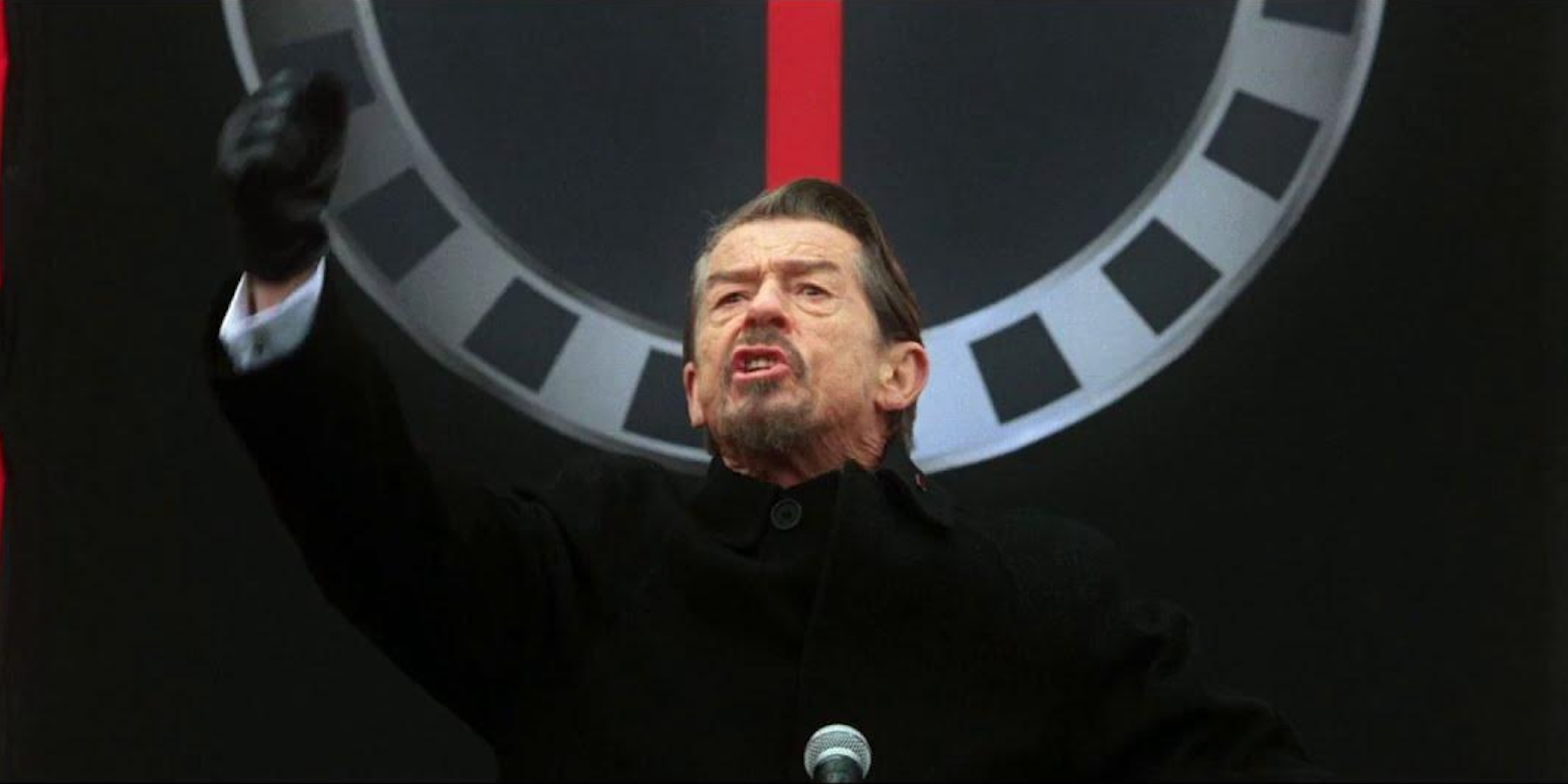
What sets this film apart from many genre entries is the coherence of its thematic armor. Every major plot beat reinforces the central investigation into how surveillance is used as a tool of control, how propaganda shapes public perception, and how fear can be engineered to justify the curtailment of liberties.
Surveillance in the Digital Age
The film’s depiction of all-seeing monitors, biometric identification, and the systematic collection of citizen data anticipated many features of the modern digital landscape. While the technology in the film is stylized, the principle—the surrender of privacy in exchange for perceived security—remains a universal concern. Today, audiences can watch and notice how the film’s fictional databases parallel real-world debates about data retention, facial recognition, and the balance between public safety and personal anonymity.
Propaganda and Media Control
Within the film’s universe, the state’s media apparatus operates relentlessly, broadcasting messages that glorify the regime while suppressing dissenting information. This dynamic mirrors real-world mechanisms where media ownership, framing, and the selective amplification of stories serve to maintain the status quo. The film invites viewers to critically assess how news cycles are curated, how misinformation can be institutionalized, and how alternative voices are often marginalized or dismissed.
Fear as a Political Instrument
Fear is portrayed not as a natural emotion but as a manufactured commodity. The regime’s reliance on terror alerts, scapegoating, and the cultivation of external threats serves to keep the populace compliant. This observation extends beyond the screen, offering a framework for analyzing how political actors may exploit public anxiety to advance agendas that would otherwise meet resistance. The film’s narrative arc, in which characters begin to question the legitimacy of fear-based governance, provides a template for critical engagement with contemporary political messaging.
Rewatch Value: Why the Film Endures
Beyond its thematic richness, the film’s craftsmanship ensures that repeated viewings yield new discoveries. The screenwriting structure, which interweaves flashbacks with present-day conspiracy revelation, rewards viewers who track subtle foreshadowing. Performances are layered; Weaving’s physicality and vocal modulation convey volumes even when the face is obscured, while Portman’s transformation from compliant citizen to resolute participant is gradual and earned.
Direction and Pacing
James McTeigue’s background in assistant directing for the Wachowskis on The Matrix trilogy inform his approach here, yet the film develops its own rhythmic identity. Action sequences are sparser but meticulously choreographed, often serving the story rather than distracting from it. The pacing allows tension to build organically, and the quieter scenes carry the weight of the film’s larger questions.
The Score and Atmosphere
Tyler Bates’ musical score complements the film’s somber, urgent tone. The integration of the “Vivaldi’s Winter” excerpt from The Four Seasons, recontextualized beneath masked rallies, creates a jarring juxtaposition that underscores the film’s core irony: classical beauty exploited by revolutionary force. The sound design, from the hum of surveillance equipment to the echo of footsteps in cavernous corridors, immerses the viewer in a world that feels oppressive yet precise.
The Paramount+ Arrival: What This Means for Viewers
The move to Paramount+ is more than a licensing update; it is an reintroduction. For long-time fans, the platform provides high-definition accessibility and the ability to revisit the film alongside contemporary sci-fi releases. For newcomers, it serves as an entry point into a story that has been referenced, quoted, and reinterpreted across various media over the past twenty years. The streaming era also enables features like curated watch parties, behind-the-scenes features, and contextual documentaries that can deepen understanding of the film’s production and its socio-political underpinnings.
Because the film’s themes have not aged out of relevance, its presence on a major streaming service ensures that conversations about surveillance, propaganda, and the fragility of liberty can continue, fueled by a text that remains as compelling today as it was in 2005.
Comparative Context Within 2000s Dystopian Cinema
The film does not exist in a vacuum. The 2000s produced several notable entries in the dystopian thriller category, each approaching the genre from a different angle. Comparing the film to its contemporaries highlights what makes it distinctive.
| Film | Year | Primary Theme | Distinguishing Element |
|---|---|---|---|
| V for Vendetta | 2005 | Totalitarian resistance and anonymity | Guy Fawkes mask becomes a global protest symbol |
| Equilibrium | 2002 | Emotional suppression and resistance | Gun-fu combat style as metaphor for reclaiming agency |
| Children of Men | 2006 | Societal collapse and hope | Gritty realism, extended takes depicting chaos |
| The Matrix Reloaded | 2003 | Simulation, choice, and prophecy | Philosophical framework within action-spectacle architecture |
Where Equilibrium leans into stylized combat as a vehicle for personal rebellion, and Children of Men pursues a documentary-like immediacy in depicting a world without offspring, this film marries its action and philosophy through a singular visual motif—the mask—that functions as both character and symbol. Its emphasis on the power of ideas, masked identity, and the notion that a single individual’s performance can ignite widespread questioning of authority sets it apart as a work that prioritizes concepts over mere survival.
Practical Engagement: Lessons for Today’s Audience
Why does a film from two decades ago still matter for viewers today? The answer lies in its provision of a framework for recognizing and interrogating the mechanisms of power that persist across eras.
Critical Thinking in an Era of Information Overload
The film’s depiction of a manipulated media environment encourages modern audiences to question the origins of the information they consume daily. Identifying sponsored content, recognizing framing techniques, and seeking diverse sources are practical skills that echo the film’s central conflict. The narrative’s insistence on the importance of an informed citizenry remains a pertinent reminder in an age where algorithms can prioritize engagement over accuracy.
Recognizing Propaganda Techniques
Viewers can practice identifying the hallmarks of state or corporate propaganda: the use of fear-inducing language, the creation of binary oppositions (“us vs. them”), the repetition of slogans, and the selective omission of context. The film’s depiction of a state-controlled broadcast system serves as a case study in how these techniques operate when consolidated under a single authority. Applying this awareness to advertising, political campaigning, and news reporting empowers individuals to navigate information ecosystems more discerningly.
The erosion of freedom, as portrayed in the film, often begins with seemingly innocuous trade-offs—convenience for privacy, security for liberty. Recognizing these early warning signs can serve as a proactive measure rather than a reactive one.
Returning to the film, or watching it for the first time through Paramount+, offers more than entertainment. It provides a moment of reflection on the patterns that have repeated throughout history and a prompt to consider one’s role within the broader tapestry of civic engagement.


Comments
Post a Comment